Next Level Real Estate Investing · Part 3 of 8
Investor Education · 4 min read
Where Do You Fit? The Real Estate Investor's Ladder
Most real estate content tells you what to buy. Almost none of it answers the question that actually matters first: what fits your income? Because the right move at $150K a year is the wrong move at $600K, and the same house can be three completely different investments depending on how you run it.
The Three Postures
Start here. A long-term rental (LTR) is the familiar one — a lease, a tenant, steady rent. A short-term rental (STR) is a property rented to guests for stays averaging seven days or less, Airbnb-style. And within STR there's a fork that changes everything: STR passive, where a manager or co-host runs the operation, and STR active, where you materially participate — genuinely running it yourself, more hours than anyone else. Here's why the fork matters. An LTR's losses are passive by default — they shelter rental income, not your salary. An STR active flips that: the losses become non-passive and can offset your W-2. But the STR passive middle rung is a trap almost nobody names: you've taken on the harder business — guests, turnovers, reviews — while the losses stay just as trapped as the LTR's. You bought the hospitality workload without the tax engine. A lot of Airbnb owners live on that rung and don't know it.
The Ladder — Where Income Meets Strategy
| Household income | Where you fit | The play |
|---|---|---|
| Under ~$150K | Foundation | LTR or house-hack; depreciation shelters rental income, not much W-2 |
| $150K–$300K | The unlock zone | First active STR; cost segregation + bonus depreciation starts meaningfully offsetting ordinary income |
| $300K–$600K | Full leverage | Larger STR or a second one; deduction sized to income — the loss cap becomes the ceiling to plan around |
| $600K+ | Portfolio mode | Multiple properties, 1031 chain, estate structure; caps and suspended losses need a real CPA plan |
The Finding That Surprised Even Me
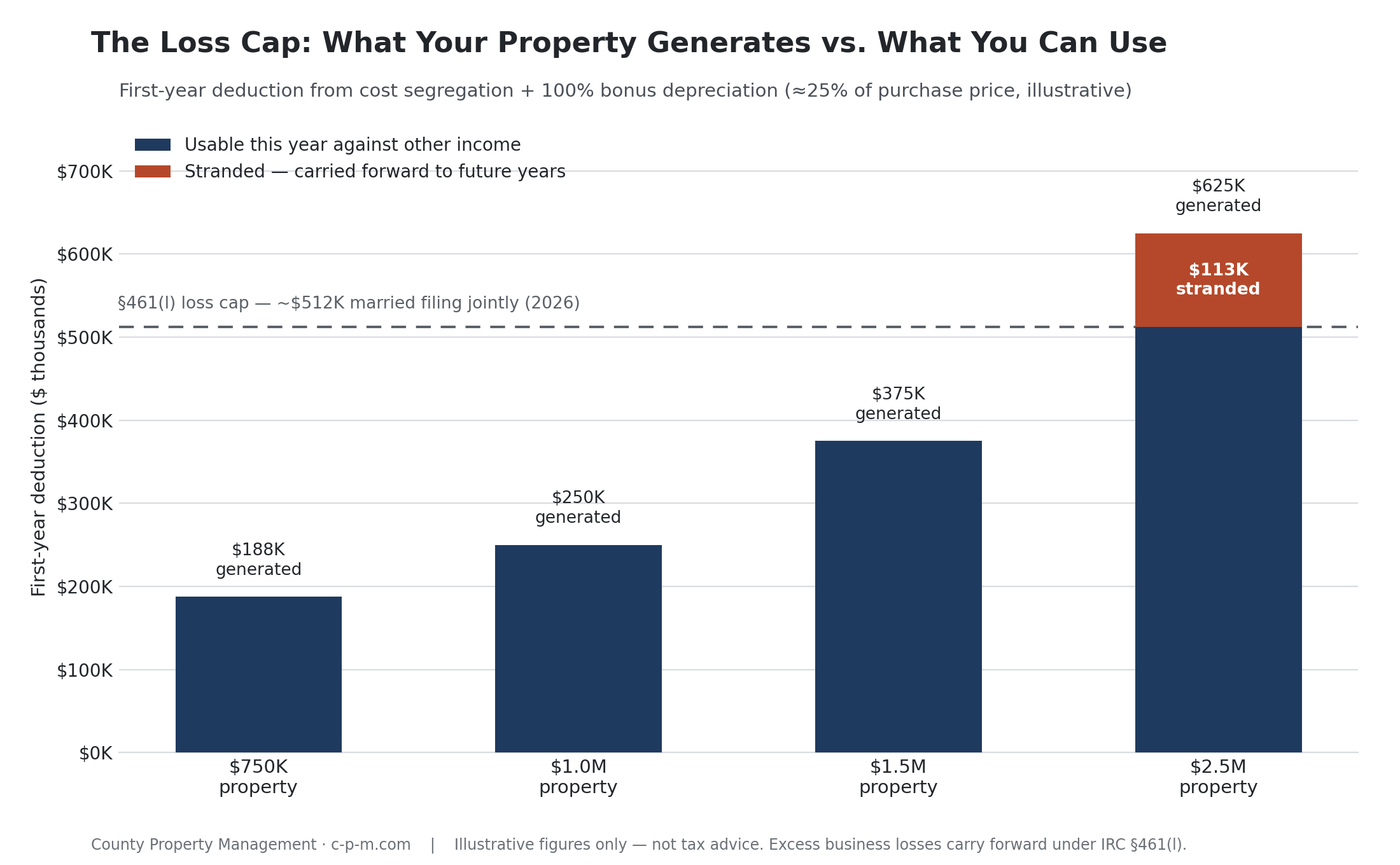
The binding constraint isn't your ambition — it's the loss cap. The tax code limits how much business loss you can use against other income in a single year (for 2026, roughly $256K single / $512K joint under §461(l); excess carries forward). Which means property price should be sized to your income, not the other way around. Buying "as much house as you can finance" can strand deductions you paid real money to create.
Two Practical Notes
Moving from passive to active is an operating decision, not a paperwork one. If you want help acquiring and launching a property while keeping the owner's operating seat — the pricing calls, guest policy, and oversight hours that material participation is made of — that's the shape of what our partners at BNB Turnkey do on the acquisition side; your CPA confirms the role you're actually playing. And whichever rung you claim, be ready to prove it: EvidenceGraph documents the participation hours as they happen, which is the difference between rung two and rung three when anyone asks. Not sure which rung is yours? That's a twenty-minute conversation, and I have it every week.
Related questions
Answered in full in our FAQ hub.