Property Manager Services · 7 min read
THE ROBOT CAN'T READ THE ROOM
THE ROBOT CAN'T READ THE ROOM
AI is genuinely useful in property management — right up until the moment it isn't. That line matters more than you think.
By Richard J. Miller · Broker, County Property Management · DRE #00578068 · Est. 1986
I've been managing residential properties in Ventura County since 1978, and running County Property Management since 1986. I've lived through paper ledgers, fax machines, property management software, online portals — and now, AI. Every wave promised to change everything. Every wave changed some things. Here's what I've figured out about this one.
Let's start with the good news for anyone who manages rental properties: AI tools are genuinely impressive at certain tasks. Drafting a lease addendum? Fast. Summarizing new rent ordinance language? Useful. Generating a maintenance request response at 11pm? Actually pretty great. If you're not using AI to handle the mechanical layer of this business, you're doing extra work you don't need to do.
But here's where it gets interesting — and where I see landlords, especially newer ones, make a critical miscalculation.
01 — WHAT AI IS ACTUALLY GOOD AT
Think of AI as an extremely well-read assistant who has never once had an awkward conversation with a tenant, never served a notice, never shown up to a property to find something unexpected, and has never personally lost a dime on a bad decision. That assistant can draft documents, pull comparable rents, summarize statutes, and outline a checklist in the time it takes you to find a pen.
That's real value. In property management, a significant portion of the work is information processing — tracking lease dates, generating notices, analyzing market rents, staying current on local ordinances. AI handles all of that without complaint, without lunch breaks, and without forgetting.
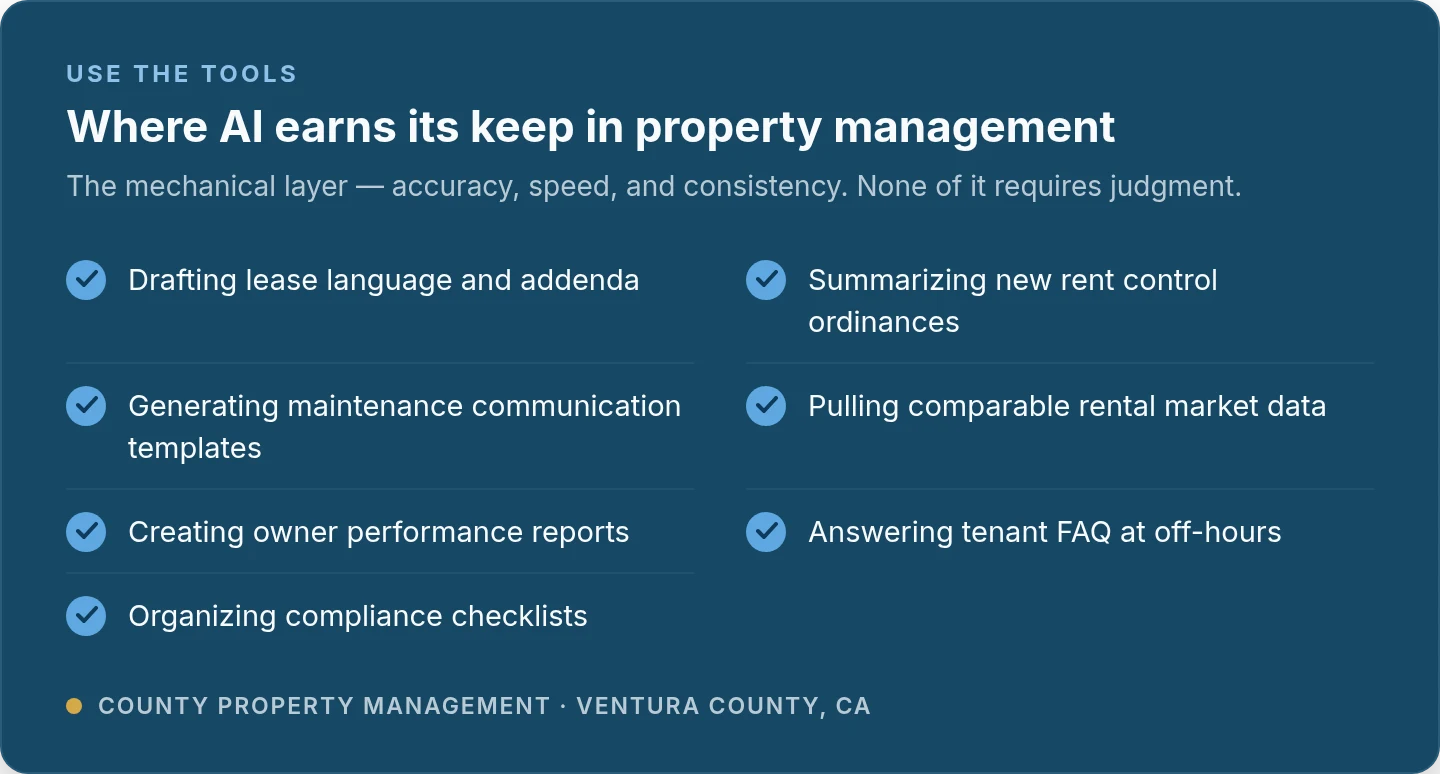
None of those things require judgment. They require accuracy, speed, and consistency. AI delivers all three. Let it.
02 — THE MOMENT THE ALGORITHM HITS ITS CEILING
A tenant texts on a Friday afternoon. Rent is due Monday. She's been with you for four years, always paid on time, and she's asking for ten days because her employer missed payroll. The software flags it: late payment incoming.
Does AI know that this tenant once called you when she noticed a slow leak under the kitchen sink — before it became a $4,000 water damage claim? Does it know this is the kind of person who treats the property as if it were her own? Does it know that serving a three-day notice to a four-year, zero-problem tenant over a payroll delay would be both legally unnecessary and strategically foolish?
No. It flags the late payment and waits for instructions.
"The algorithm sees a data point. The experienced manager sees a person, a history, a risk calculation, and a long-term business decision — all at once, in under a minute."
That gap — between what the data shows and what the situation actually calls for — is where professional property management lives. And it is entirely irreplaceable by software, no matter how good the software gets.
03 — THE LIABILITY NOBODY TALKS ABOUT
Here's something that should get your attention if you own rental property in California: the legal exposure in this business is asymmetric. One procedural error in an eviction notice — wrong date, wrong statutory language, wrong service method — and you're starting over. In Oxnard, in any city that has adopted just-cause protections, the sequence of steps matters as much as the steps themselves.
AI can draft your three-day notice. It cannot be accountable for it. It cannot appear in court. It cannot be held liable when the timing is wrong because it didn't know the tenant's situation had a nuance that changed the calculus.
An experienced property manager carries that accountability — personally, professionally, with a license on the line. That's not theater. That's a structural difference in what's at stake for us versus what's at stake for a software tool.
04 — LOCAL KNOWLEDGE IS NOT IN THE DATABASE
I've worked in Ventura County for nearly four decades. I know which Camarillo neighborhoods are transitioning. I know which courts move slowly. I know which vendors show up when they say they will — and which ones don't. I know that a property that pencils one way on paper sometimes operates very differently based on where it sits and who tends to rent it.
You cannot scrape that from the internet. You cannot train a model on it. It lives in the head of someone who has been doing this work, in this market, long enough to have made the expensive mistakes and learned from them.
When a new investor asks me whether a particular fourplex in Oxnard makes sense as a rental, my answer isn't a cap rate. It's a conversation — about the block, the current ordinance exposure, the tenant profile that property tends to attract, the maintenance history that type of construction generates. AI gives you the cap rate. I give you the conversation.
05 — THE RELATIONSHIP IS THE ASSET
Here's the thing that never shows up in a rent roll: good tenants stay because of how they're treated.
Tenant turnover in residential property management is expensive in ways that are easy to undercount — lost rent during vacancy, leasing costs, make-ready expenses, the energy of starting over with an unknown occupant. Every quality tenant who stays another year instead of leaving is real money that never appears as income on any spreadsheet.
The relationship that keeps a good tenant in place is built on small moments: a maintenance request handled the same day, a renewal conversation that felt like a conversation instead of a transaction, a manager who remembers that you mentioned your mother was in the hospital. AI can send a maintenance confirmation. It cannot make someone feel that they matter.
"Retention is a relationship problem. It has always been a relationship problem. No software update changes that."
06 — SO WHAT DOES THIS MEAN FOR YOU?
If you self-manage your rentals and you're not using AI tools to handle the mechanical layer, you should be. There's no medal for doing by hand what software does better. Use it for drafting, for tracking, for research, for first-pass communication. That's time you get back.
But if you're under the impression that AI tools — or any software — can substitute for professional management, you're solving the wrong problem. The software handles tasks. The experienced manager handles situations. Those are not the same thing.
The landlord-tenant relationship in 2026 is more legally complex, more politically charged, and more financially consequential than at any point in my career. Cities like Oxnard and Ojai have expanded tenant protections significantly. The margin for procedural error is thin. The cost of getting it wrong is not.
In that environment, the wisdom in the room matters. Experience matters. Judgment — slow, seasoned, hard-earned judgment — matters more than ever.
AI can help with the work. It just can't do the job.
County Property Management has managed residential properties across Ventura County since 1986. If you'd like to talk through whether professional management makes sense for your property, call us at (805) 482-9800 or visit c-p-m.com.
Richard J. Miller Broker & Founder, County Property Management DRE #00578068 (805) 482-9800 · c-p-m.com 1100 Flynn Road, Suite 205 · Camarillo, CA 93012
Related questions
- Can AI manage a rental property on its own?→
- What is the first step to evict a tenant in California?→
- Should I use AI tools to help self-manage my rentals?→
- What is the risk of a mistake in a California eviction notice?→
Answered in full in our FAQ hub.